Stop building agents like prompts. Build them like state machines.
Durable execution (Temporal, Restate, Inngest), idempotency keys for tool calls, and human-in-the-loop as an interrupt primitive.
Apr 19, 202611 min read46
Search for a command to run...
Series
The industry spent 2024–2025 building agents like prompts: role-play a "researcher, " role-play a "planner, " role-play a "critic, " wire them together with a prompt, ship to production, debug in Slack.
It didn't work. Research claims that >75% of multi-agent systems become unmanageable past five agents. Production agent observability is a black box; your APM shows green while the agent has burned $4,200 on a failure mode nobody has a dashboard for. Prompt-injection defences live inside each app, get re-implemented wrong, and drift.
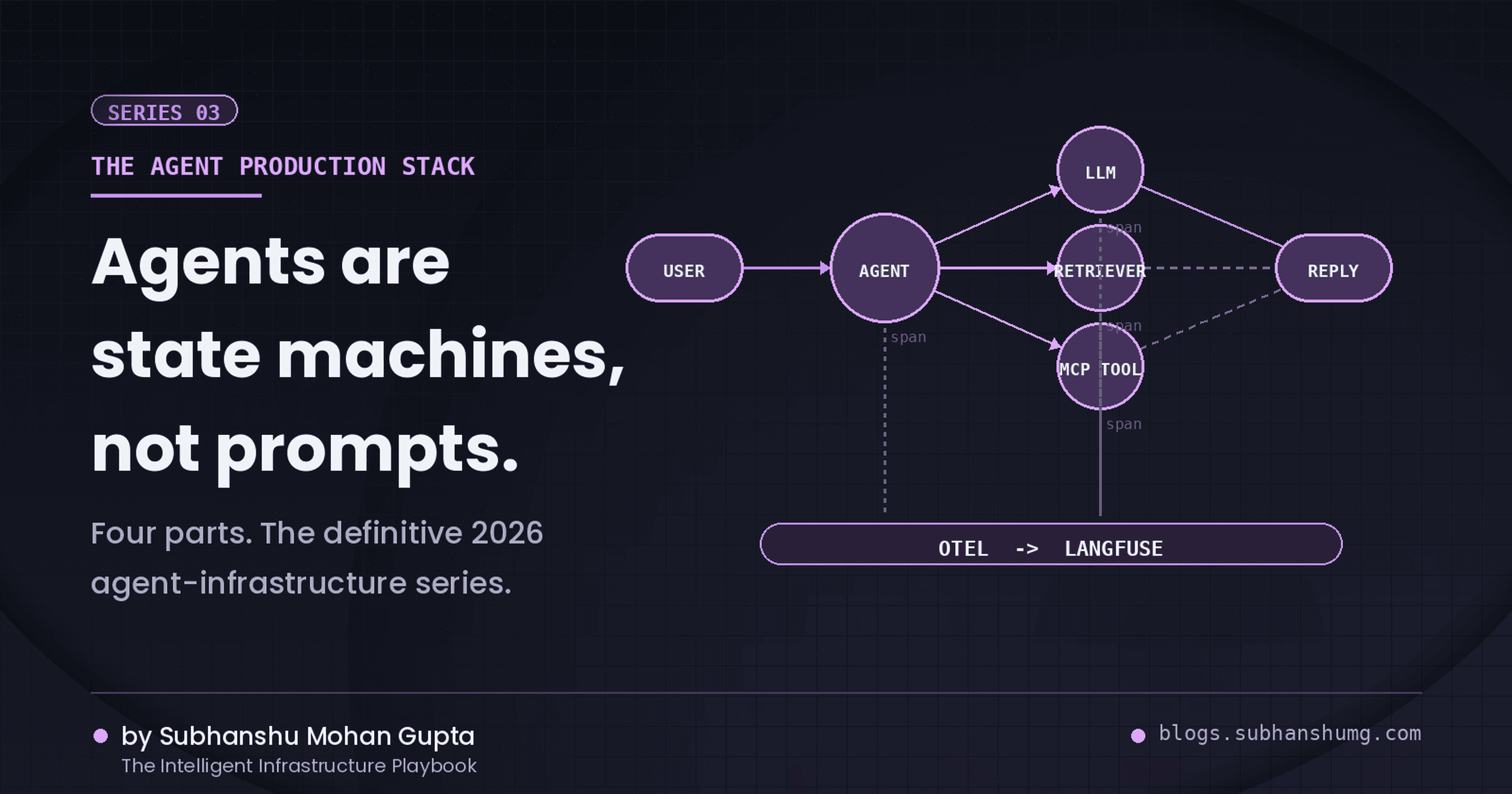
The winning 2026 pattern is not "more agents." It is fewer agents, better tools, durable execution, OpenTelemetry gen_ai traces, platform-level guardrails, and SPIFFE-based identity. That is an infrastructure problem, not a modelling problem which is exactly why this is a Playbook series.
The through-line: Every article in this series refuses the "agents are just prompts" framing. The unit of architecture is the platform primitive traces, state machines, policy, identity, not the agent itself.