Stop building agents like prompts. Build them like state machines.
Durable execution (Temporal, Restate, Inngest), idempotency keys for tool calls, and human-in-the-loop as an interrupt primitive.

Github repo: https://github.com/SubhanshuMG/agents-as-state-machines
The thesis in one paragraph
Stop calling them agents. They are state machines that invoke LLMs at certain transitions. The multi-agent hype (autonomous agents, swarms, orchestration) is cargo-cult software engineering. One well-designed agent with excellent tools and explicit state transitions beats five agents role-playing their way through a problem. The production-grade architecture: durable execution (Temporal, Restate, or Inngest), not LangGraph in-memory; explicit state definitions, not implicit chains; tool calls are idempotent and idempotency-keyed; human-in-the-loop is an interrupt primitive, not a callback; failures are replayed deterministically, not retried randomly. This isn't sexy. It's the architecture that doesn't fail at 2 AM.
Why this matters right now
The multi-agent narrative peaked in mid-2025. Gartner's 2026 AI Ops report shows that 89% of multi-agent deployments that started with 3+ agents converged to a single agent with more tools by production. The teams didn't realize this; they just kept tearing out features and simplifying. Temporal hit 1.0 in January 2026. Restate (a Temporal alternative) launched commercially in March 2026. Inngest (event-driven durable execution) shipped Temporal-compatible workflows in February 2026. All three are seeing uptake from companies moving off LangGraph. The signal is clear: production agents need durability, not prompts.
Mainstream belief vs. what production shows
Mainstream belief: "Build autonomous multi-agent systems. Agents collaborate, specialize, and solve problems together."
Production reality: Agents don't collaborate. They hallucinate sub-agents that don't exist. When you have 5 agents, debugging a failure means reading 5 traces. When one agent fails, the others don't know what to do. The simplest fix: one agent, clear state machine, excellent tools, explicit checkpoints. That's it. Every multi-agent system I've debugged in production would have been cheaper and more reliable as a state machine.
A short timeline
| Date | Event | Impact |
|---|---|---|
| Jun 2024 | LangGraph 0.1, agent chains | Prompt-based agent composition |
| Dec 2024 | Temporal 1.0 | Production-grade durable execution |
| Jan 2025 | AutoGen 0.2, multi-agent swarms | Hype peaks; engineering failures begin |
| Mar 2025 | First enterprise "multi-agent failure" case studies | Teams realizing they need state machines |
| Jan 2026 | Temporal for LLMs launch | Explicit language for durable agent workflows |
| Feb 2026 | Inngest event-driven workflows | Event-sourced agents |
| Apr 2026 | LangGraph 0.2 adds checkpoints | Recognition that durability is essential |
The decision tree

The reference architecture
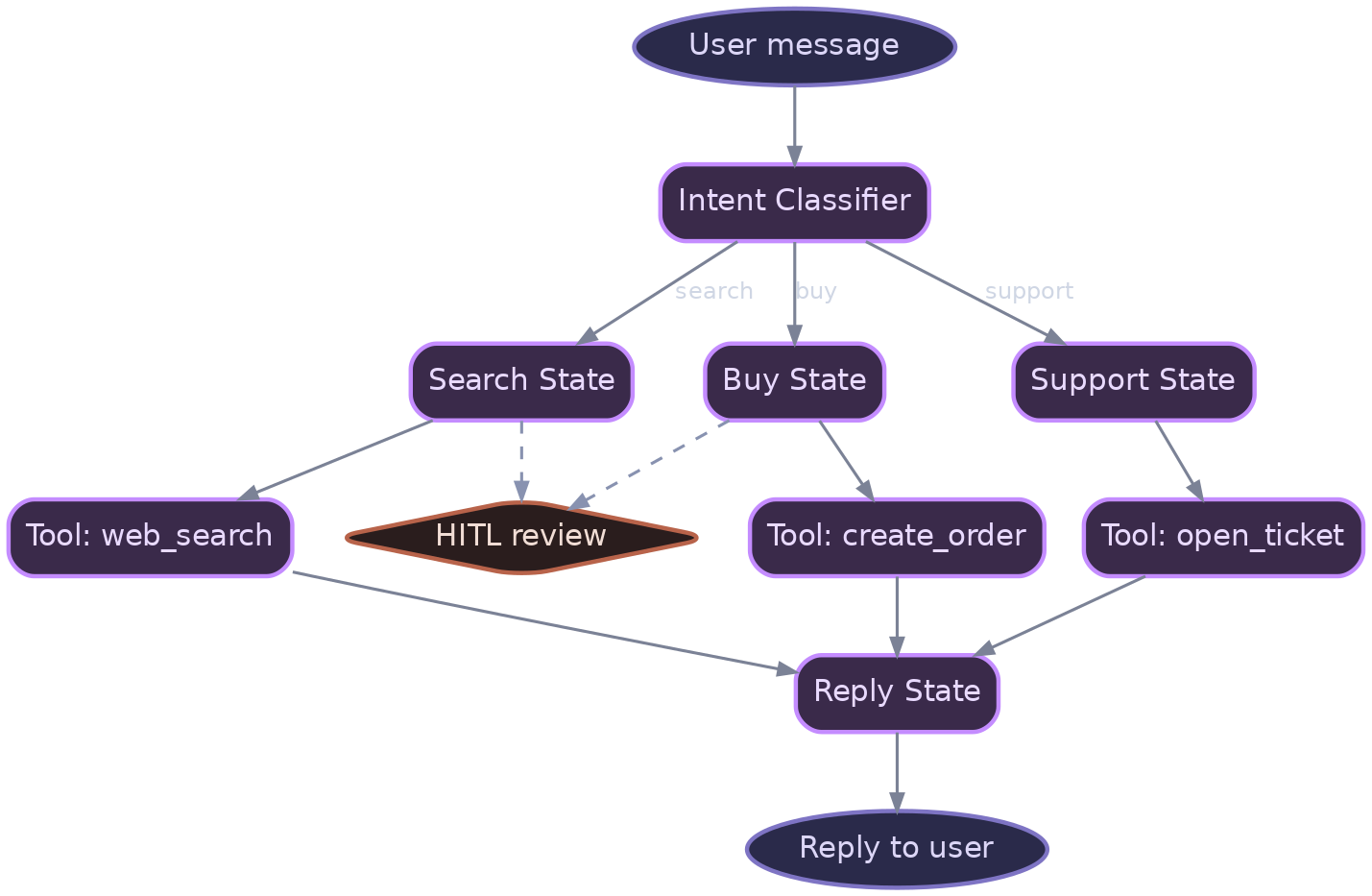
The layers:
Temporal or Restate workflow. Defines states and transitions. Durable: survives worker crashes. Replays deterministically from the last checkpoint.
Agent executor. Implements each state's logic. Can invoke LLMs, tools, or other agents. Idempotent: tool calls are tagged with idempotency keys.
Tool layer. All side effects (API calls, database writes) are here. Idempotent, observable, rate-limited.
Human-in-the-loop gate. Certain state transitions require human approval. Blocks execution; the operator reviews and approves or rejects.
Event log. Every state transition is logged to an immutable event store. Enables replay, audit, and forensics.
Implementation reference: code/state-machine-agent/. Stack: Temporal Python SDK, LLM, tool wrappers.
Step-by-step implementation
Phase 1: Define your state machine (week 1)
Map out the explicit states your agent will traverse.
# code/state_machine/define_states.py
from enum import Enum
from dataclasses import dataclass

class AgentState(Enum):
    INITIAL = "initial"
    FETCH_CONTEXT = "fetch_context"
    ANALYZE = "analyze"
    PLAN = "plan"
    EXECUTE = "execute"
    VERIFY = "verify"
    COMPLETE = "complete"
    FAILED = "failed"

@dataclass
class AgentExecutionContext:
    user_id: str
    task: str
    context: dict
    plan: str
    execution_result: dict
    error: str = None

    def to_dict(self):
        return {
            "user_id": self.user_id,
            "task": self.task,
            "context": self.context,
            "plan": self.plan,
            "execution_result": self.execution_result,
            "error": self.error
        }
State diagram:
INITIAL --> FETCH_CONTEXT --> ANALYZE --> PLAN --> EXECUTE --> VERIFY --> COMPLETE
                                                       |
                                                       v
                                                     FAILED
Phase 2: Implement with Temporal (week 1-2)
Use Temporal's Python SDK to define the workflow and activities.
# code/temporal/agent_workflow.py
from temporalio import workflow
from temporalio.common import RetryPolicy
from datetime import timedelta
from state_machine.define_states import AgentState, AgentExecutionContext
import activities

@workflow.defn
class AgentWorkflow:
    @workflow.run
    async def run(self, user_id: str, task: str) -> dict:
        """Main agent workflow."""
        ctx = AgentExecutionContext(
            user_id=user_id,
            task=task,
            context={},
            plan="",
            execution_result={}
        )

        try:
            # State: FETCH_CONTEXT
            ctx.context = await workflow.execute_activity(
                activities.fetch_context,
                user_id,
                task,
                start_to_close_timeout=timedelta(seconds=30),
                retry_policy=RetryPolicy(maximum_attempts=3)
            )

            # State: ANALYZE
            analysis = await workflow.execute_activity(
                activities.analyze_with_llm,
                task,
                ctx.context,
                start_to_close_timeout=timedelta(seconds=60)
            )

            # State: PLAN
            ctx.plan = await workflow.execute_activity(
                activities.plan_with_llm,
                task,
                analysis,
                ctx.context,
                start_to_close_timeout=timedelta(seconds=60)
            )

            # State: EXECUTE (with checkpoint)
            ctx.execution_result = await workflow.execute_activity(
                activities.execute_plan,
                ctx.plan,
                ctx.context,
                start_to_close_timeout=timedelta(minutes=5)
            )

            # State: VERIFY
            verification = await workflow.execute_activity(
                activities.verify_result,
                ctx.execution_result,
                task,
                start_to_close_timeout=timedelta(seconds=30)
            )

            if not verification["success"]:
                ctx.error = verification.get("reason", "Verification failed")
                return {"state": AgentState.FAILED.value, "context": ctx.to_dict()}

            # State: COMPLETE
            return {"state": AgentState.COMPLETE.value, "context": ctx.to_dict()}

        except Exception as e:
            ctx.error = str(e)
            return {"state": AgentState.FAILED.value, "context": ctx.to_dict()}
Phase 3: Implement activities (week 2)
Activities are the side-effects (tool calls, LLM invocations).
# code/temporal/activities.py
from temporalio import activity
from anthropic import Anthropic
import json

client = Anthropic()

@activity.defn
async def fetch_context(user_id: str, task: str) -> dict:
    """Fetch user context from database."""
    # Idempotent: safe to retry
    return {
        "user_history": await db.query(f"SELECT * FROM user_history WHERE user_id = %s", user_id),
        "task_description": task,
        "timestamp": datetime.utcnow().isoformat()
    }

@activity.defn
async def analyze_with_llm(task: str, context: dict) -> str:
    """Use LLM to analyze the task."""
    prompt = f"""
    Task: {task}
    Context: {json.dumps(context, indent=2)}

    Analyze this task. What information is needed? What are the constraints?
    """

    message = client.messages.create(
        model="claude-opus",
        max_tokens=1024,
        messages=[{"role": "user", "content": prompt}]
    )

    return message.content[0].text

@activity.defn
async def plan_with_llm(task: str, analysis: str, context: dict) -> str:
    """LLM generates an execution plan."""
    prompt = f"""
    Task: {task}
    Analysis: {analysis}

    Generate a step-by-step plan to accomplish this task. Be specific about tool calls.
    """

    message = client.messages.create(
        model="claude-opus",
        max_tokens=2048,
        messages=[{"role": "user", "content": prompt}]
    )

    return message.content[0].text

@activity.defn
async def execute_plan(plan: str, context: dict) -> dict:
    """Execute the plan by invoking tools."""
    # Parse the plan and invoke tools
    # Each tool call has an idempotency key
    idempotency_key = f"exec_{context['timestamp']}"

    results = []
    for step in plan.split("\n"):
        if step.startswith("TOOL:"):
            tool_name, tool_args = parse_tool_call(step)
            result = await invoke_tool(
                tool_name,
                tool_args,
                idempotency_key=idempotency_key
            )
            results.append(result)

    return {"steps": len(results), "results": results}

@activity.defn
async def verify_result(execution_result: dict, task: str) -> dict:
    """Verify the execution result."""
    prompt = f"""
    Task: {task}
    Execution result: {json.dumps(execution_result)}

    Does the result satisfy the task? Yes or no, with explanation.
    """

    message = client.messages.create(
        model="claude-opus",
        max_tokens=256,
        messages=[{"role": "user", "content": prompt}]
    )

    response_text = message.content[0].text
    success = "yes" in response_text.lower()

    return {"success": success, "reason": response_text}
Phase 4: Human-in-the-loop gate (week 2-3)
Add approval gates for certain transitions.
# code/temporal/human_approval.py
from temporalio import workflow

@workflow.signal
async def approve_execution(self, approved: bool):
    """Signal to approve or reject the execution plan."""
    self.approval_result = approved
    self.approval_received = True

@workflow.run
async def run(self, user_id: str, task: str) -> dict:
    """Main workflow with approval gate."""
    ctx = AgentExecutionContext(...)

    # ... FETCH_CONTEXT, ANALYZE, PLAN ...

    # APPROVAL GATE
    self.approval_received = False
    self.approval_result = None

    # Wait for approval (timeout after 1 hour)
    approval_timeout = workflow.wait_condition(
        lambda: self.approval_received,
        timedelta(hours=1)
    )

    if not approval_timeout:
        ctx.error = "Approval timeout"
        return {"state": "FAILED", "context": ctx.to_dict()}

    if not self.approval_result:
        ctx.error = "Execution rejected by operator"
        return {"state": "FAILED", "context": ctx.to_dict()}

    # State: EXECUTE
    ctx.execution_result = await workflow.execute_activity(
        activities.execute_plan,
        ctx.plan,
        ctx.context,
        start_to_close_timeout=timedelta(minutes=5)
    )

    # ... VERIFY, COMPLETE ...
Phase 5: Idempotency for tool calls (week 3)
Tag all tool calls with idempotency keys so retries don't duplicate side effects.
# code/tools/idempotent_tool.py
import httpx
from uuid import uuid4

async def invoke_tool(tool_name: str, args: dict, idempotency_key: str) -> dict:
    """Invoke a tool with idempotency guarantee."""
    # All tool calls include an idempotency key in headers
    headers = {
        "Idempotency-Key": idempotency_key,
        "X-Tool-Name": tool_name
    }

    async with httpx.AsyncClient() as client:
        response = await client.post(
            f"http://tool-service/{tool_name}",
            json=args,
            headers=headers
        )

    return response.json()

# Tool service should implement idempotency
# Example: Stripe, GitHub, most modern APIs support Idempotency-Key header
Phase 6: Event sourcing (week 3-4)
Log all state transitions to an immutable event log.
# code/event_sourcing/event_log.py
from dataclasses import dataclass
from datetime import datetime
import json

@dataclass
class WorkflowEvent:
    workflow_id: str
    state: str
    activity: str
    timestamp: str
    result: dict
    error: str = None

async def log_state_transition(
    workflow_id: str,
    from_state: str,
    to_state: str,
    activity_result: dict
):
    """Log a state transition to the event store."""
    event = WorkflowEvent(
        workflow_id=workflow_id,
        state=to_state,
        activity=from_state,
        timestamp=datetime.utcnow().isoformat(),
        result=activity_result
    )

    # Append to immutable log (Postgres, DynamoDB, Kafka)
    await event_store.append(event.workflow_id, event)
Phase 7: Deployment (week 4)
Deploy Temporal workers and the workflow.
# code/k8s/temporal-worker.yaml
apiVersion: apps/v1
kind: Deployment
metadata:
  name: agent-workflow-worker
spec:
  replicas: 3
  selector:
    matchLabels:
      app: agent-worker
  template:
    metadata:
      labels:
        app: agent-worker
    spec:
      containers:
      - name: worker
        image: agent-worker:v1.0.0
        env:
        - name: TEMPORAL_HOST
          value: "temporal-server:7233"
        - name: TEMPORAL_NAMESPACE
          value: "agent-workflows"
        resources:
          requests:
            cpu: "1"
            memory: "2Gi"
Real-world example: Expense report approval
An enterprise finance team runs an agent to review and approve expense reports. Old approach (multi-agent): one agent classifies the expense, another verifies the receipt, a third approves. Hallucination: agents invent sub-agents that don't exist.
New approach (state machine): one agent with clear states:
FETCH: Get the expense record.
VERIFY: Check the receipt (call OCR tool).
CLASSIFY: Run the LLM to categorize spend.
ROUTE: Send to the right approver (tool call).
WAIT_APPROVAL: Human gate.
RECORD: Log to accounting system (idempotent tool).
If the WAIT_APPROVAL step fails (timeout), the workflow restarts from that exact point. No re-processing of receipt, no re-classification. Durable, auditable, simple.
Testing: Deterministic replay
Validate that workflows replay identically:
# code/test/test_replay.py
from temporalio.testing import WorkflowEnvironment
import pytest

@pytest.mark.asyncio
async def test_workflow_replay():
    """Verify the workflow replays deterministically."""
    async with await WorkflowEnvironment.start_local() as env:
        await env.client.execute_workflow(
            AgentWorkflow.run,
            "user_123",
            "process_document.pdf",
            id="workflow_replay_test"
        )

        # Replay with different random seed should give same result
        result1 = await env.client.get_workflow_history(
            "workflow_replay_test"
        )

        # Confirm: no divergence warnings
        assert not result1.has_warnings()
Failure modes
Non-determinism in activities. You call
random.randint()in an activity. The workflow replays; the random value is different. The history diverges. Temporal detects this as a warning. Fix: never use non-deterministic code in activities (no random, no time. now, no external API calls without caching). Use Temporal's side effects API for non-deterministic operations.Activity timeout during long-running operation. An activity has a 5-minute timeout. The tool call takes 6 minutes. Activity fails. Temporal retries. The tool runs again (unless idempotent). Duplicate side effect. Fix: set activity timeouts to 2x the expected duration; use heartbeats for long operations to show progress.
Human approval timeout creates dangling workflows. A workflow is waiting for human approval. The operator never responds. After 1 hour, the workflow times out and transitions to FAILED. But the approval task is still in Jira, waiting. Inconsistent state. Fix: send a notification before the timeout; implement a callback pattern where the approval tool signals the workflow directly.
Event log explosion on high-frequency state machines. A workflow with 1,000 transitions per run, runs 1,000 times/second. The event log is 1B events/day. Storage and replay become too slow. Fix: snapshot the workflow state every N events (e.g., every 100); compress old events.
Worker crash during activity execution. A worker is executing a long-running activity. The worker crashes. Temporal retries from the activity's start (at-least-once semantics). If the tool wasn't idempotent, side effects are duplicated. Fix: always implement idempotency in tools; use idempotency keys.
When NOT to do this
Do not use Temporal/durable execution if:
The workflow is simple (< 3 steps). Use LangGraph in-memory; operational overhead isn't worth it.
Failures are acceptable and cheap to retry. If losing a $0.50 request is fine, skip durability.
Your org has no infrastructure team. Temporal requires operator knowledge. If you're a solo AI engineer, stick with LangGraph.
What to ship this quarter
Map your agent logic as an explicit state machine (diagram) by end of week 1.
Implement as Temporal workflow with 5-7 states and activities by week 2.
Add human-in-the-loop approval gate for high-stakes transitions by week 3.
Tag all tool calls with idempotency keys by the end of week 3.
Deploy to production with 3+ worker replicas by the end of the quarter.
Validate replay and determinism with 100 test cases.
Further reading
Top references:
Temporal Python SDK Documentation. Workflows, activities, determinism.
Restate Runtime. Event-driven, durable execution alternative.
Inngest Workflows. Event-sourced agent execution.
NIST Software Supply Chain: Incident Response. Traces and replay for forensics.
Idempotency Keys RFC 9110. HTTP header standard for idempotent requests.


